
Red Light Strip

Red Light Strip

A knee sleeve that gives red and near-infrared light while it stretches with the leg. 326 LEDs sit inside a 3D-knitted spacer, 5 mm off the skin, and run at set currents from a 2000 mAh pod, so one 20 minute session delivers the 4 J/cm² the client asked for over almost the whole knee.

A knee sleeve that gives red and near-infrared light while it stretches with the leg. 326 LEDs sit inside a 3D-knitted spacer, 5 mm off the skin, and run at set currents from a 2000 mAh pod, so one 20 minute session delivers the 4 J/cm² the client asked for over almost the whole knee.

Client

LightTreeVentures, LED light therapy

Scope

Dose, heat, stretchable circuit, CAD and drawings

Materials

Spacer knit, printed silver on TPU, 660 and 850 nm LEDs

Constraint

4 J/cm² in 20 minutes, skin under 41 °C

96%

96%

of the knee gets half the mean dose or more; bare LEDs reach 28%

4 J/cm²

4 J/cm²

in one 20 minute session, 3.3 mW/cm² on average

40.9 °C

40.9 °C

hottest skin under an LED just after exercise, under the 43 °C limit

326

326

LEDs in 49 strings, each at a set current

How it works

How it works

The sleeve is a 3D-knitted spacer fabric: two knit faces 5 mm apart, held by springy yarns. The LEDs sit in that gap on small islands and face the skin through a clear silicone dome, so they cannot be felt and their light spreads before it lands.

The sleeve is a 3D-knitted spacer fabric: two knit faces 5 mm apart, held by springy yarns. The LEDs sit in that gap on small islands and face the skin through a clear silicone dome, so they cannot be felt and their light spreads before it lands.

Spacer knit

Holds every LED 5 mm off the skin, lets sweat and heat out, and is the 3D-knitted base the client asked for.

Strings at a set current

Six zone drivers hold each string at 12 or 18 mA, so stretch and trace resistance do not change the light.

Pod on the outer thigh

Battery, USB-C charging, a 15 V boost, the timer and one button. It clips off for washing.

The wall from the skin side: liner, spacer knit, LEDs on islands, printed strings and the copper bus, outer knit.

Client and team

Client and team

LightTreeVentures builds LED light therapy for health and personal wellness. They asked for a sleeve that fits like a brace without its support: stretchable, 3D knitted, comfortable for 20 minutes, with red and infrared LEDs in the right places.

LightTreeVentures builds LED light therapy for health and personal wellness. They asked for a sleeve that fits like a brace without its support: stretchable, 3D knitted, comfortable for 20 minutes, with red and infrared LEDs in the right places.

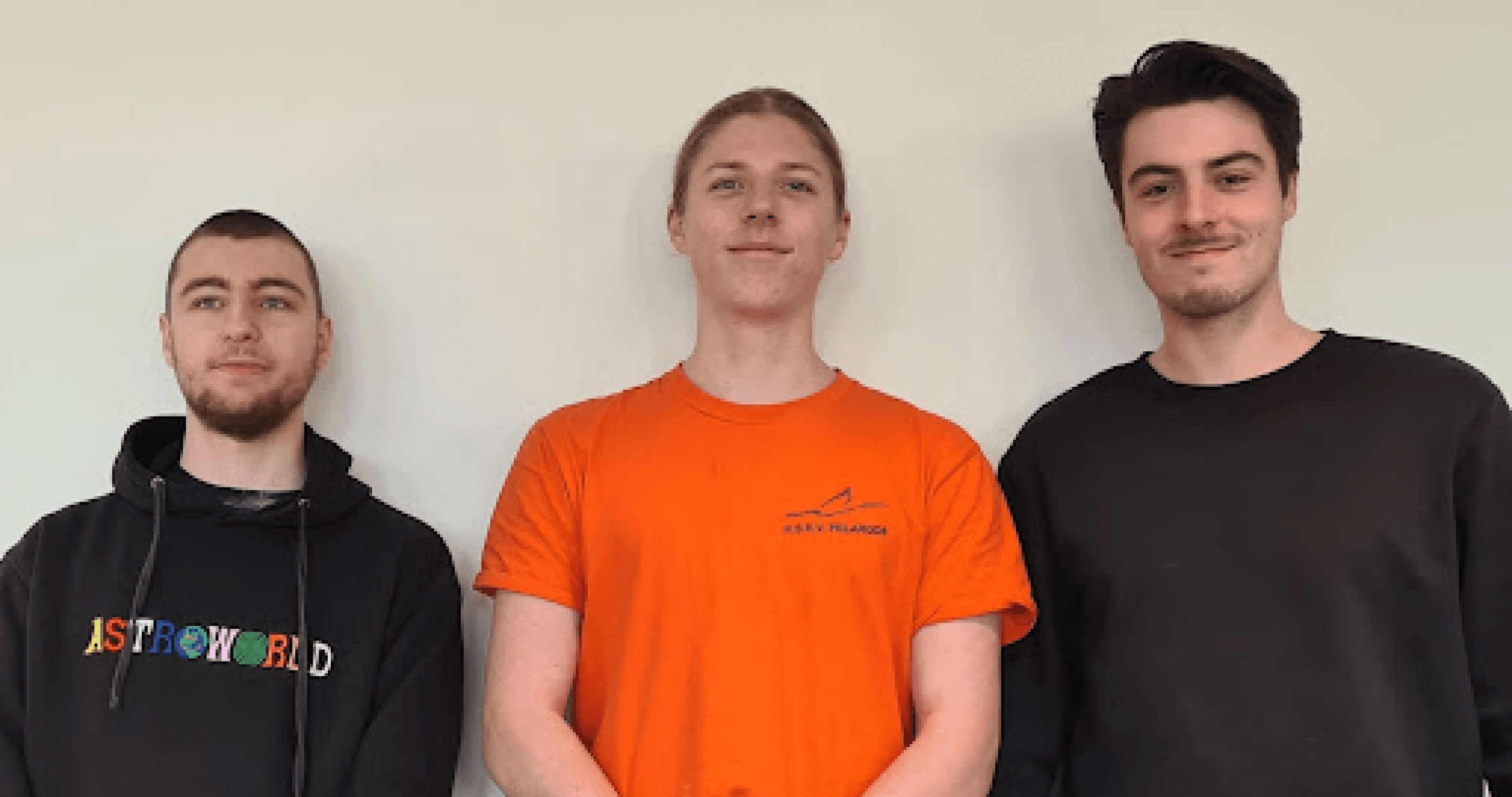
Team BDSL was four Industrial Design Engineering students at The Hague University of Applied Sciences: Lorenzo Bouman, Sem Geilenkirchen, Dorian Hofmann and Beck Prat. I led materials and prototyping, from February to July 2023. LightTreeVentures took over our prototypes and documents for their own product work.

Team BDSL was four Industrial Design Engineering students at The Hague University of Applied Sciences: Lorenzo Bouman, Sem Geilenkirchen, Dorian Hofmann and Beck Prat. I led materials and prototyping, from February to July 2023. LightTreeVentures took over our prototypes and documents for their own product work.

A sleeve in use after training: lit LED rows around the knee, the pod on the thigh and a 20 minute timer on a phone

AI-generated image

Three members of team BDSL

Who it is for, from the team survey

67%

67%

train three times a week or more

63%

63%

have used a support sleeve

8%

8%

have used light therapy

75%

75%

call comfort and breathability very important

Most respondents would pay 70 to 100 euro, and most doubted the effect, so evidence and price both matter.

From brief to numbers

From brief to numbers

Each line of the 2023 brief became a number to compute and a test to run. The left column quotes the brief.

Each line of the 2023 brief became a number to compute and a test to run. The left column quotes the brief.

Brief

Red Light Strip

How it is checked

Red at 660 nm, infrared at 830 nm

660 and 850 nm LEDs. 830 nm sits on the flank of a standard 850 nm LED; an 830 nm part is the option if the trial asks for it

Datasheet, spectrometer

LEDs should emit 4 J/cm²

3.3 mW/cm² mean for 20 minutes; 96% of the skin gets half the mean or more

Irradiance model, radiometer map

Comfortable for longer than 20 minutes

LEDs 5 mm off the skin in the spacer; hottest skin 40.9 °C just after exercise

Heat model, thermocouple trial

Electronics stretch with the knit

Printed silver meanders that open 138% before the silver strains; rows run around the leg

Strain model, cyclic stretch test

Current health product safety standards

Near-infrared at the eye 7.7 W/m² against 100 W/m² (IEC 62471); skin under 43 °C (IEC 60601-1)

Calculation, test lab

Hand washable

Pod clips off; LEDs and circuit sealed in TPU inside the knit

ISO 6330 wash cycles

USB-C charging

USB-C, about 1.7 h at 5 V, 1 A

Specification

Battery for 20 minutes

3.56 Wh per session; 2000 mAh gives 1.8 sessions new, 1.4 aged

Energy model, discharge test

One fixed setting, one hand

One button, one 20 minute programme

User test

A price early adopters accept, 70 to 100 euro

Parts and assembly about €57 at 10,000; not met at a usual margin

Cost model

What the prototypes showed

What the prototypes showed

In 2023 we tested every part by hand: fabrics, conductors, circuits and trace shapes. These results are where the new design starts.

In 2023 we tested every part by hand: fabrics, conductors, circuits and trace shapes. These results are where the new design starts.

The five fabrics tested: tricot, polyester mesh, stretchable bamboo, tricot scuba and camo polyester

Lycra scuba won

Five fabrics, scored on campus and tested by hand: scuba stretched to 118%, let water through in 11 seconds against 2 for mesh and 57 for tricot, and scored 4.1 of 5 on feel.
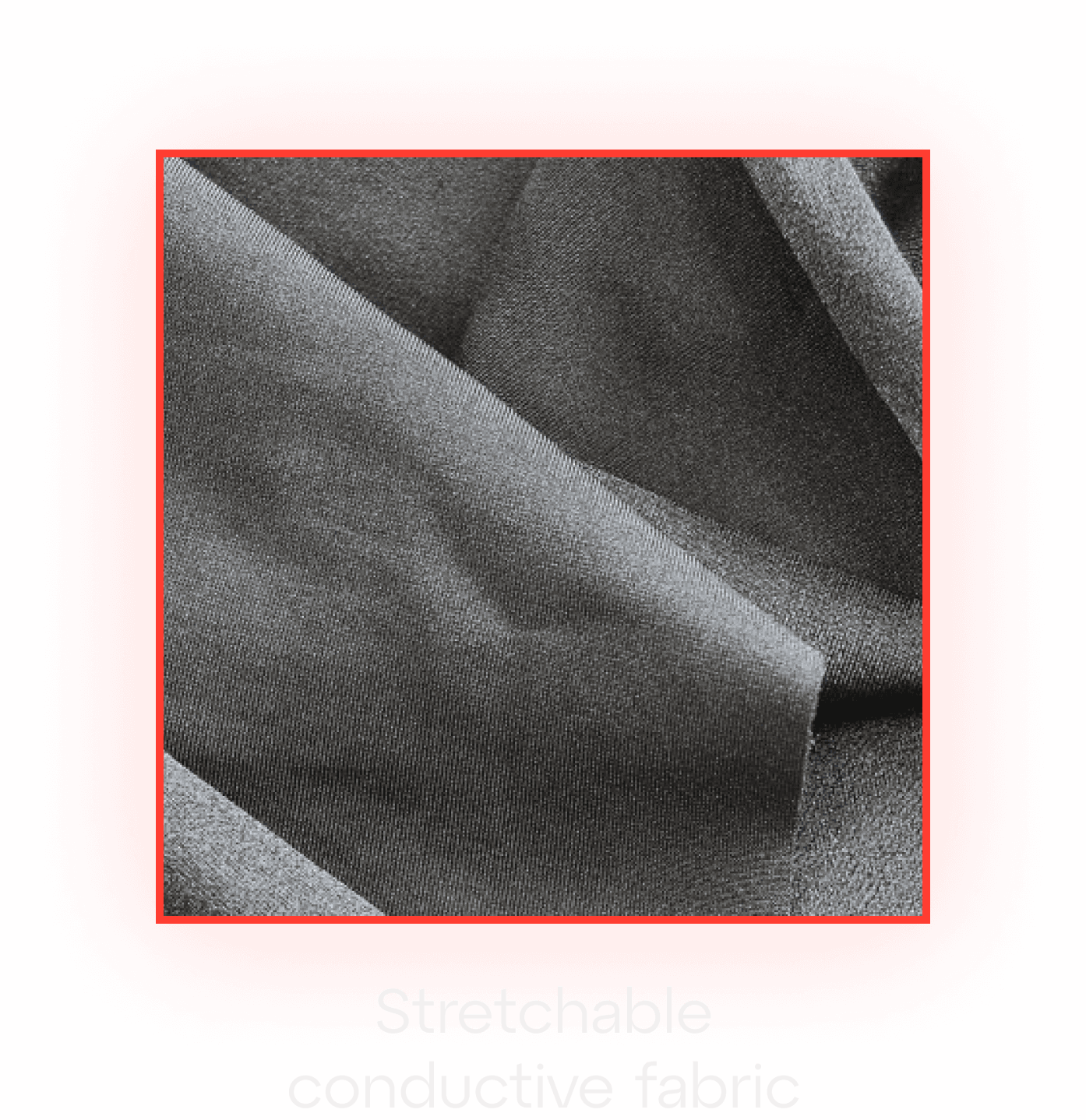
Stretchable conductive fabric

Fabric stretches, yarn snaps

A 10 cm strip of stretch conductive fabric reached 35 cm; the conductive yarn broke at 8%. Stretched, the strip passed more current at 2.7 V: 25 mA at rest, 70 mA at 25 cm.
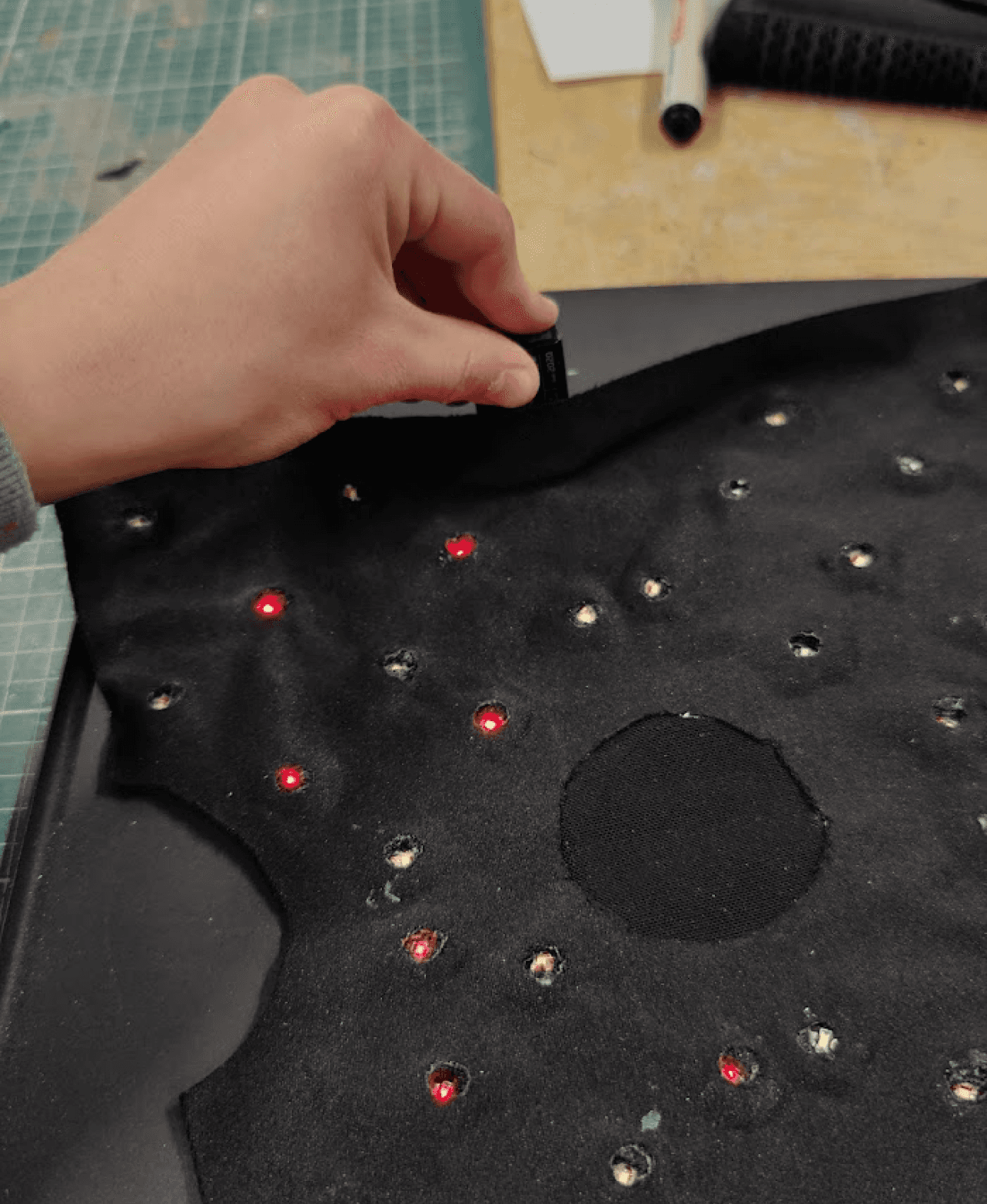
The panel with its LEDs lit

Series stayed dark

On a 3 V coin cell only LEDs in parallel lit. Two red LEDs in series need about 3.9 V, so the cell, not the fabric, was the limit.
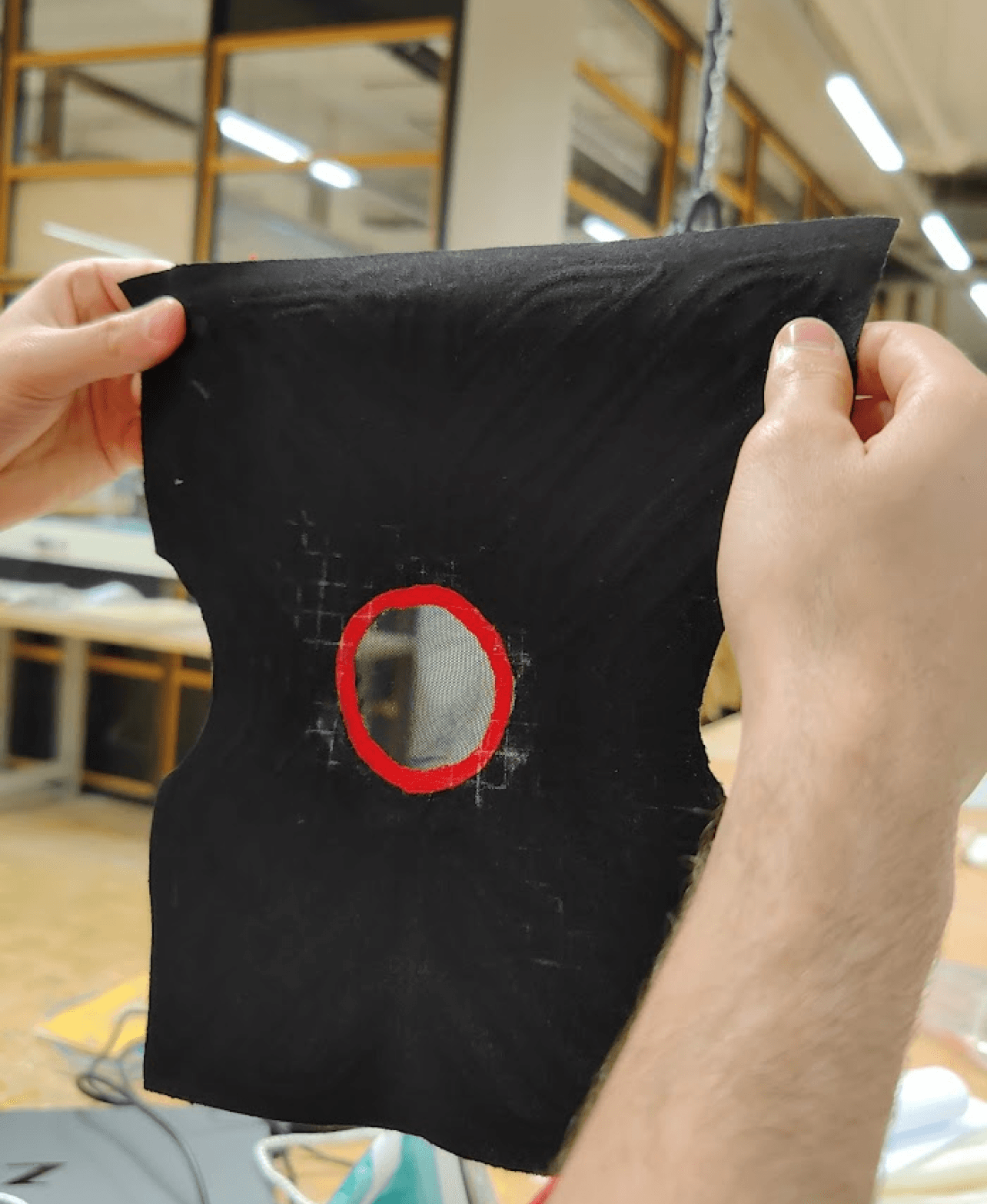
First sleeve panel with the kneecap ring

The first sleeve panel

Laser-cut conductive fabric on stretch knit, Lilypad LEDs and a red ring round the kneecap: the panel this page develops into a product.
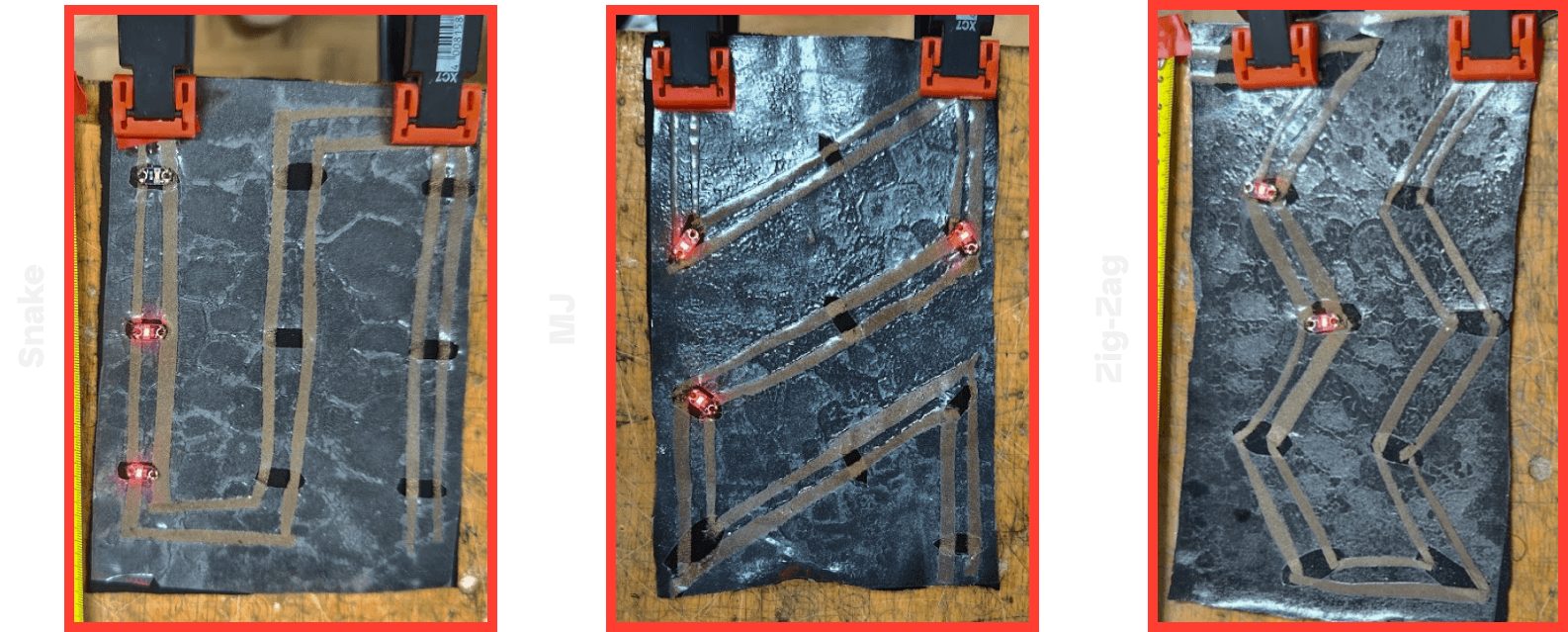
Three trace patterns on test samples: snake, Z and zigzag, with LEDs lit

Three trace shapes

Straight, Z-shaped and zigzag traces of conductive fabric, glued to the knit with LEDs sewn on.
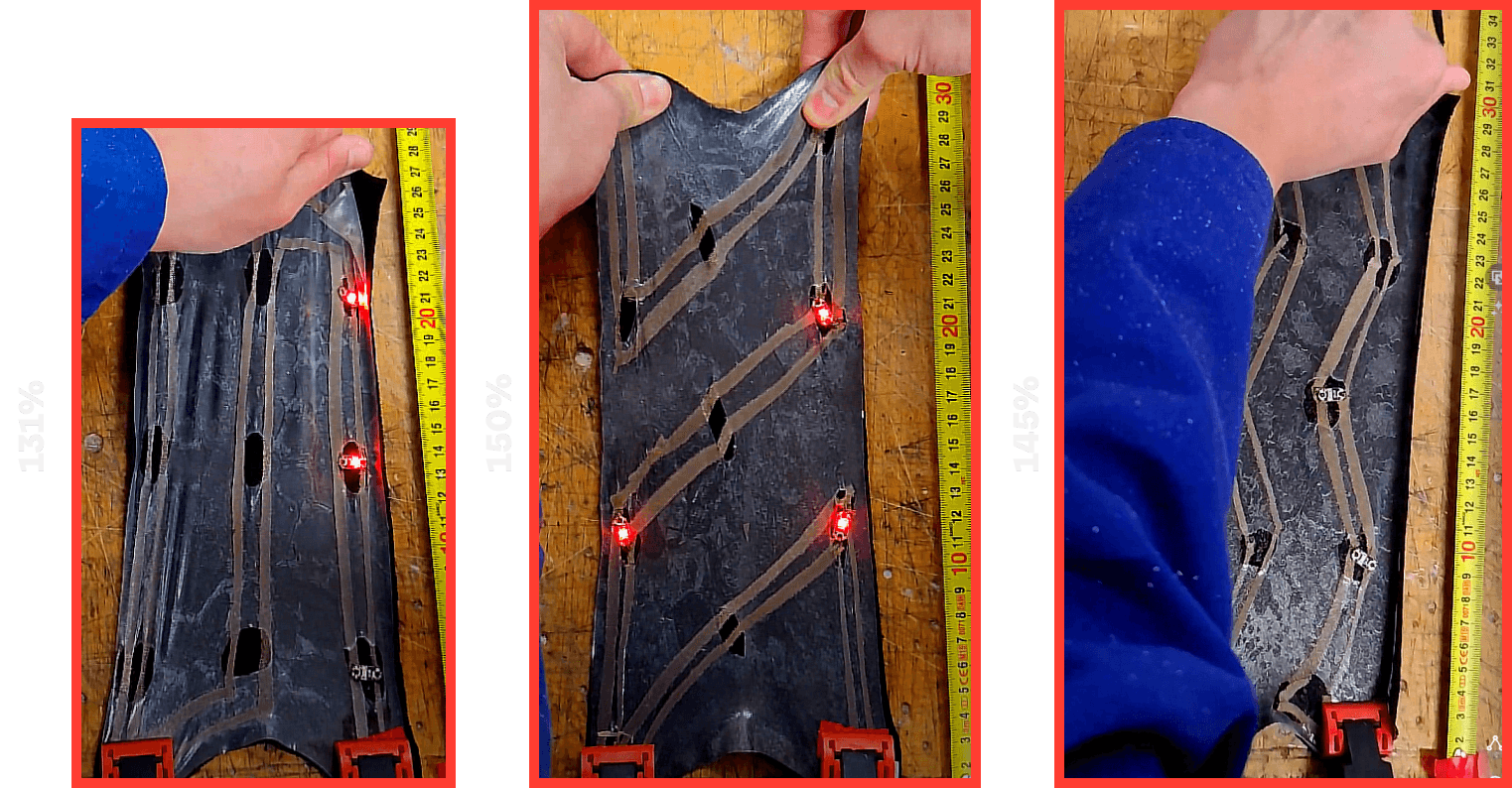
The three samples stretched against a tape measure: 131, 150 and 145 percent

Z stretched furthest

The samples held to 131% (straight), 150% (Z) and 145% (zigzag) of their length. Weighted on stretch, breakage, making and waste, Z scored 695, straight 670 and zigzag 465.

Photos from the 2023 prototypes and tests.

Light where it lands

Light where it lands

The client’s target is 4 J/cm² per session, which over 20 minutes means 3.3 mW/cm² on average. The average is the easy part. An LED 1.5 to 2 mm from the skin lights a spot a few millimetres wide, so on the prototype 12% of the skin got half the average or more, and a dense grid of bare LEDs still only 28%.

The client’s target is 4 J/cm² per session, which over 20 minutes means 3.3 mW/cm² on average. The average is the easy part. An LED 1.5 to 2 mm from the skin lights a spot a few millimetres wide, so on the prototype 12% of the skin got half the average or more, and a dense grid of bare LEDs still only 28%.

In the spacer knit the same LEDs sit 5 mm off the skin and their light overlaps: 96% of the skin gets half the mean or more, and all of it does 2 mm under the surface. The 2023 concept card promised a circuit that covers 90% of the skin; with the spacer that holds.

In the spacer knit the same LEDs sit 5 mm off the skin and their light overlaps: 96% of the skin gets half the mean or more, and all of it does 2 mm under the surface. The 2023 concept card promised a circuit that covers 90% of the skin; with the spacer that holds.

Hand sketch of the spacer knit in section: two knit layers 5 mm apart on springy yarns, an LED hanging in the gap and its light overlapping on the skin

AI-generated sketch

Irradiance maps at the skin for the prototype, bare LEDs and LEDs in the spacer knit
Chart of the share of skin at half the mean dose or more against LED distance from the skin, for three spacings

How far off the skin

How far off the skin

Coverage climbs steeply between 3 and 5 mm of stand-off at a 17 mm spacing. Closer LEDs need less stand-off but more LEDs, more joints and more cost; 5 mm is also the thickness of an ordinary neoprene knee sleeve.

One question stays open for the trial. 4 J/cm² over the 897 cm² the sleeve covers is about 3.6 kJ per session, while a 2018 review found 60 to 300 J per large muscle group worked best before exercise. Light therapy is biphasic, more is not better, so the dose stays adjustable and the first trial compares two settings.

Chart of the hottest skin temperature under an LED against LED spacing, at rest and after exercise, with the 41 and 43 degree lines

Heat sets the spacing

Heat sets the spacing

About 60% of the power into an LED becomes heat right at the skin. For a fixed dose, fewer LEDs means more current and more heat each, so the hottest spot under an LED climbs as the spacing grows.

With skin at 35.5 °C just after exercise, a 17 mm spacing keeps the hottest point at 40.9 °C, under the 41 °C target and the 43 °C that IEC 60601-1 allows for skin contact of 10 minutes or more. At 22 mm it would pass 43 °C.

The model adds the even warming of the knee, 1.9 °C, to the spot under one LED, 3.4 °C, with blood flow carrying heat away and the knit holding it in. A sensor on each zone island stops the session at 41 °C.

Traces that do not feel the stretch

Traces that do not feel the stretch

Skin over the front of the knee stretches by up to about 30% in deep flexion. The team’s samples showed which shapes survive that: straight traces held to 131% of their length, zigzags to 145%, the Z-shaped diagonal to 150%.

Skin over the front of the knee stretches by up to about 30% in deep flexion. The team’s samples showed which shapes survive that: straight traces held to 131% of their length, zigzags to 145%, the Z-shaped diagonal to 150%.

A trace at an angle to the stretch is pulled less, because the knit narrows as it lengthens. At 150% a straight trace stretches 50%, a 25° zigzag 40%, a 60° diagonal only 3%. Fitted to the straight sample, the model puts the zigzag’s limit at 139%, close to the 145% measured.

A trace at an angle to the stretch is pulled less, because the knit narrows as it lengthens. At 150% a straight trace stretches 50%, a 25° zigzag 40%, a 60° diagonal only 3%. Fitted to the straight sample, the model puts the zigzag’s limit at 139%, close to the 145% measured.

Hand sketch of the sleeve from the front and the side: rows of LEDs run around the leg, a kneecap window, no LEDs behind the knee

AI-generated sketch

Chart of strain in the trace against sample stretch for straight, zigzag and Z traces, with the team samples marked

The three sample shapes stretched to 150% and back, each segment coloured by the strain that reaches it.

So the strings run around the leg, where the knit stretches least, as horseshoe meanders that can open by 138% before the silver itself strains, and the long runs stay off the front of the knee.

So the strings run around the leg, where the knit stretches least, as horseshoe meanders that can open by 138% before the silver itself strains, and the long runs stay off the front of the knee.

Chart of light output along a line of ten LEDs for fabric traces, printed silver and constant-current strings

A set current for every string

A set current for every string

The prototype put every LED in parallel on conductive fabric. Each strip of fabric is a resistor, so LEDs further along get less voltage: with ten LEDs on a 5 mm fabric line the last gives 4% of the light of the first, and about 14% on a 15 mm line, which is why the team made the traces 15 mm wide.

The series test failed for a simpler reason: the coin cell could not reach the voltage. With a 15 V boost, series strings are the better choice on fabric. Six zone drivers hold each string of up to 6 red or 8 near-infrared LEDs at a set current, so trace resistance, and the way it changes when the knit stretches, no longer changes the light.

The strings are printed silver. The 0.7 A bus that feeds the zones is copper meanders: printed silver would lose 7.1 V on the way to the far zone, copper loses 0.57 V.

System diagram: pod, bus, six zone drivers and the red and near-infrared strings, with the energy per session

The sleeve

The sleeve

Size M: 300 mm long for a 38 cm knee. A 55 mm kneecap window ringed in red silicone, no LEDs in the 90 by 110 mm relief behind the knee where the knit bunches, grip bands at both ends, and the pod on the outer thigh.

Size M: 300 mm long for a 38 cm knee. A 55 mm kneecap window ringed in red silicone, no LEDs in the 90 by 110 mm relief behind the knee where the knit bunches, grip bands at both ends, and the pod on the outer thigh.

Red Light Strip knee sleeve with its LEDs lit, red light lines around it
Red Light Strip knee sleeve with the LEDs off: black knit, red kneecap ring and stripes, pod on the outer thigh
Exploded wall of the sleeve: liner, spacer knit, LEDs on islands with domes, printed strings and copper bus on TPU, outer knit

Part

Material

Made by

Outer knit

Polyester with elastane, the scuba-type knit that won the fabric test

Flat-bed 3D knitting, in one piece with the spacer

Spacer knit

Polyester faces held 4 mm apart by monofilament yarns

Knitted together with the outer face, pockets for the islands

Strings and pads

Stretchable silver ink on 0.15 mm TPU film

Screen printed, laminated by heat press

Bus

Copper meanders on polyimide, sealed in TPU

Flexible circuit

LED islands

165 at 660 nm and 161 at 850 nm on 6.8 mm polyimide islands, clear silicone domes

Pick and place, domes dispensed

Zone islands

Six 12-channel constant-current drivers, one temperature sensor each

Pick and place

Pod

Li-Po 3.7 V 2000 mAh, USB-C, boost, timer, in a sealed housing

Injection moulded, clips off for washing

Grip bands

Silicone

Printed inside both ends

Made in five steps

Made in five steps

Every step uses a process that already exists for sportswear or flexible electronics; the new part is putting them in one sleeve.

Every step uses a process that already exists for sportswear or flexible electronics; the new part is putting them in one sleeve.

Step

How

Check

Knit

Sleeve and spacer knitted in one piece on a flat-bed machine, with pockets for the islands

Weight and stretch per batch

Print

Silver strings and pads screen printed on TPU film, then cured

Sheet resistance, continuity

Place

LEDs and zone drivers placed on their islands, domes dispensed

Light output per string

Laminate

Circuit laminated into the knit by heat press

Peel strength, stretch to 130% with the circuit on

Close and test

Pod fitted, every string run at its set current, sample checks to IEC 62471

Current per string, skin temperature on a dummy leg

Hand sketch of the 46 by 62 by 13 mm pod with one button and USB-C, clipped off the sleeve before washing

AI-generated sketch

Bar chart of the cost of parts and assembly per sleeve

What it costs

What it costs

About €57 for parts and assembly at 10,000 pieces, so the sleeve would sell for over €200 at the usual margin: twice what the survey suggested. The LEDs, their drivers and the knit are most of it.

Either the price follows the evidence the client can show, or the lit area shrinks. That is a choice to make with LightTreeVentures before tooling.

Safety and claims

Safety and claims

Light, heat, the battery and the words on the box each have their own rules.

Light, heat, the battery and the words on the box each have their own rules.

Eyes

With every LED on, the near-infrared reaching an eye 200 mm away is 7.7 W/m², against the 100 W/m² that IEC 62471 allows for long exposure. The sleeve still switches off when it is not worn.

Skin

Hottest skin 40.9 °C after exercise; IEC 60601-1 allows 43 °C for contact over 10 minutes. Each zone switches off at 41 °C.

Battery

A protected 2000 mAh Li-Po cell, tested to IEC 62133 and UN 38.3 for transport, inside a pod that clips off before washing.

Claims

Pain relief or injury healing would make it a medical device under the EU MDR, likely class IIa as an active device that delivers energy. Warm-up and recovery keep it a consumer product. The page, the box and the manual have to say the same thing.

Design review

Design review

Ten findings from the models and the 2023 tests, each with the change it caused.

Ten findings from the models and the 2023 tests, each with the change it caused.

Finding

Change

The prototype’s LEDs sat 1.5 mm from the skin and lit 12% of it

LEDs moved into the spacer knit, 5 mm off the skin: 96%

Series strings failed on a 3 V coin cell

15 V boost and a set current per string

Fabric traces dim the far LEDs to 4 to 14% of the first

Constant-current strings, printed silver strings, copper bus

Straight traces carry all of the stretch

Rows around the leg as horseshoe meanders

Behind the knee the knit bunches in flexion

No LEDs in a 90 by 110 mm relief

After exercise the hottest skin nears the limit

17 mm spacing, 40.9 °C, and a 41 °C cut-out per zone

The 2023 documents name 1500, 2000 and 2500 mAh

2000 mAh: one session needs 1416 mAh at end of life

The brief asks for 830 nm

850 nm LEDs, with 830 nm as an option for the trial

4 J/cm² over the whole knee is 3.6 kJ, more than per-muscle doses in the literature

Adjustable dose, two settings in the first trial

Parts cost about €57 against a 70 to 100 euro price

Price and lit area decided together before tooling

Drawings

Drawings

The flat pattern as cut, the LED island in section with the string between two islands, and the system. Click a drawing to see it full size.

The flat pattern as cut, the LED island in section with the string between two islands, and the system. Click a drawing to see it full size.

Flat pattern of the size M sleeve with the LED layout, strings, zone islands, bus, kneecap window and pod
Section through one LED island in the wall of the sleeve, and the meander between two islands

Test plan

Test plan

The models make the case; these tests decide it, starting with the two numbers that set everything else: the dose map and the skin temperature.

The models make the case; these tests decide it, starting with the two numbers that set everything else: the dose map and the skin temperature.

Test

What it answers

Passes when

Radiometer map on a dummy leg

Is the dose as even as the model says?

Half the mean or more on 90% of the area

Skin thermocouples, 20 minutes after a run

Does the heat model hold?

Hottest point under 41 °C

Cyclic stretch, 10,000 cycles to 130%

Do the strings survive the knee?

Every string within 5% of its current

Wash, ISO 6330, 20 cycles

Does the sealed circuit survive washing?

No dead LEDs, no lifting

IEC 62471 measurement

Is it in the exempt group?

Exempt

Two-week comfort trial

Are 20 minutes comfortable?

LEDs not felt, no marks on the skin

Dose trial, two settings

Which dose do users notice?

A clear preference, or none

Battery, 300 cycles

Sessions per charge at end of life

At least one full session
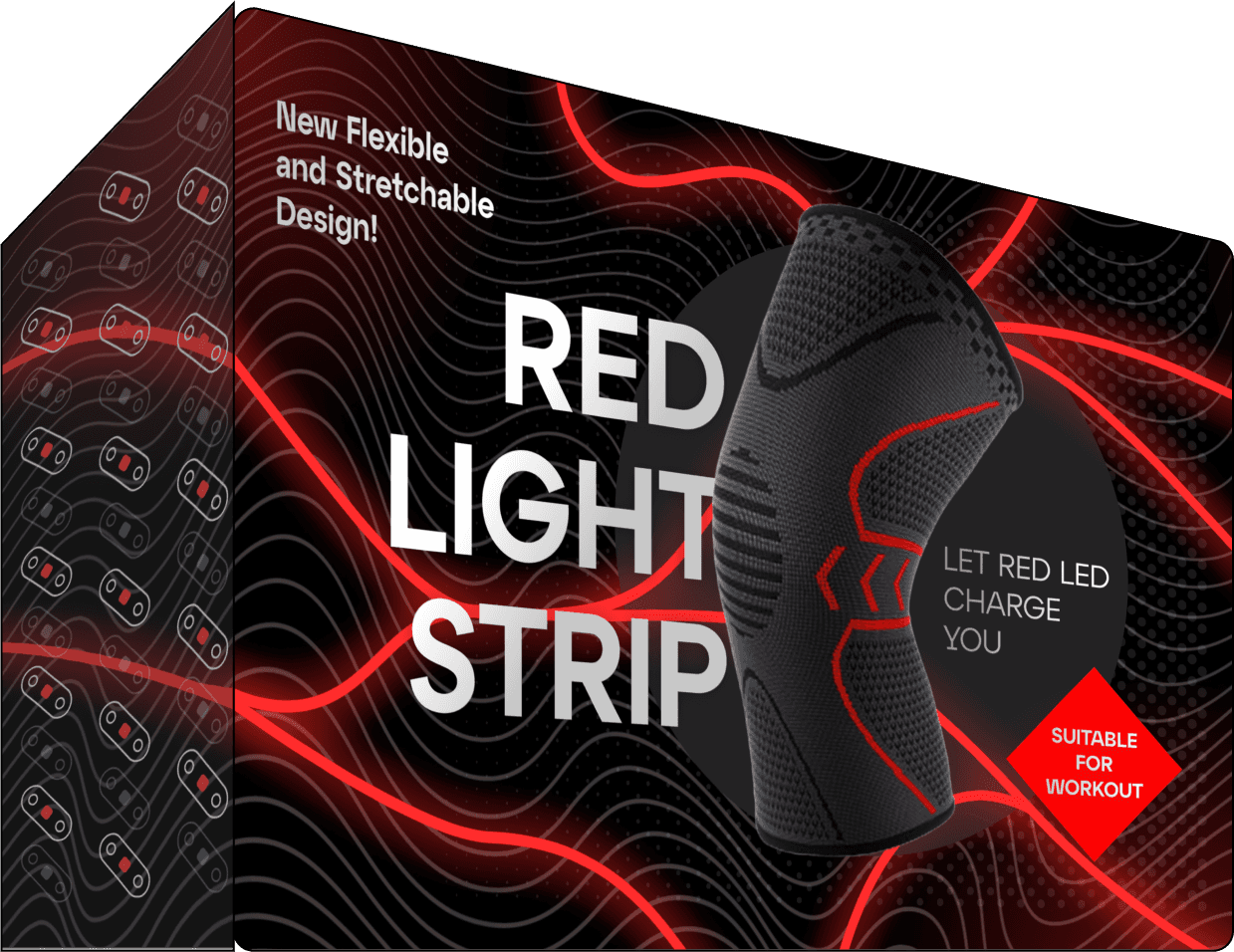
Package, poster and expo

Package, poster and expo

We closed the 2023 project with a package, a poster and a stand at the expo. LightTreeVentures adopted the prototypes and documents, offered the team positions after graduation, and keeps the project box in their office.

We closed the 2023 project with a package, a poster and a stand at the expo. LightTreeVentures adopted the prototypes and documents, offered the team positions after graduation, and keeps the project box in their office.

Red Light Strip package
Red Light Strip poster
Beck at the expo stand with the package and prototypes

What I would do next

What I would do next

Build one size M sleeve with the spacer knit and printed strings, and measure the dose map and the skin temperature on a dummy leg. Those two numbers decide spacing, current and the pod. Then run the two-dose trial with LightTreeVentures, and only then tool the knit and the print.

Build one size M sleeve with the spacer knit and printed strings, and measure the dose map and the skin temperature on a dummy leg. Those two numbers decide spacing, current and the pod. Then run the two-dose trial with LightTreeVentures, and only then tool the knit and the print.

Sources: team brief, research paper and experiments (2023); Lin et al., IEEE TBME 64(12), 2017; Vanin et al., Lasers Med Sci 33, 2018; Huang et al., Dose-Response 9(4), 2011; IEC 60601-1; IEC 62471; Laird SilverTek 3080-500 datasheet. Models and estimates are labelled as such.

After training

After training

A 20 minute session on the changing room bench. One press on the pod at the outer thigh starts the programme, the LEDs light the knee from inside the spacer knit, and the kneecap stays open.

A 20 minute session on the changing room bench. One press on the pod at the outer thigh starts the programme, the LEDs light the knee from inside the spacer knit, and the kneecap stays open.

Red Light Strip on a knee during a session on a changing room bench, the LEDs glowing red through the knit, lockers blurred behind
Close-up of the kneecap window with its red silicone ring and the lit LEDs around it
The pod clipped to the sleeve on the outer thigh, its status light on, with lit LEDs beside it

Renders of the size M sleeve during a session: the kneecap window with its red ring, and the pod on the outer thigh with its status light on.

Get in touch

Beck Prat, Medior Product Design Engineer, is open to UX, Product, and Engineering roles.

Get in touch

View CV

LOCATION

The Hague, NL

STATUS

Available now

ELIGIBILITY

Work eligible in NL, EU, EAEU

Quick recruiter summary

Selected work

PackBack, Philips, JDE Peet’s, Sonion, Stichting Stunt

Focus

Digital tools, physical products, brand systems

Collaboration

Product, engineering, stakeholders

Get in touch

Beck Prat, Medior Product Design Engineer, is open to UX, Product, and Engineering roles.

Contact

View CV

LOCATION

The Hague, NL

STATUS

Available now

ELIGIBILITY

Work eligible in NL, EU, EAEU

Quick recruiter summary

Selected work

PackBack, Philips, JDE Peet’s, Sonion, Stichting Stunt

Focus

Digital tools, physical products, brand systems

Collaboration

Product, engineering, stakeholders